
Quick answer
A sales funnel is simply the path someone takes from first hearing about you to hiring you: awareness, interest, purchase. Every business already has one, even if your clients only come through word of mouth. You don’t need a complicated funnel with email sequences and webinars, you need one that fits your business and your clients. To see yours, trace where your last three good clients came from: how they heard about you, what made them reach out, and what happened next.
Prefer listening?
I know for a fact, that some of you believe you don’t have a funnel.
And I get it, a funnel sounds like the kind of thing marketers on Instagram are constantly trying to sell you as a package. The kind of thing you need a course to understand and apply. The kind of thing that proves you’re “serious enough” about your business.
So when someone mentions funnels, introverted service providers often think: that’s not for me. I’m not that kind of business.
I’m here to tell you something different: you already have a funnel. Right now. Whether you like know it or not.

And once you understand that, your perspective on your marketing actions changes and improves.
By the end of this article, I’m going to show you what your funnel (probably) looks like and more importantly, why knowing this removes the pressure to overcomplicate everything in your marketing.
So stay with me, it’s going to be good.
Why you think you don’t have a funnel
First of all: here’s what happens when you think you don’t have a funnel, or you act as you don’t want one: You watch someone else’s case study. The business looks like yours, but they make much more. Instagram to email to webinar to course… and you think: I need that, but how do I do that? Or worse: I can’t do that.
So you’re stuck in this messy middle, trying to copy something someone else did but you don’t really know what you should copy. Maybe you do a few similar things but it doesn’t produce results, so you feel wrong or behind.
At the same time though, you’ve already got clients coming to you. Maybe through introductions, referrals, someone who heard about you from a friend, someone saw a post you did a few weeks ago and reacted. All of them, went through a path before they decided to reach you.
Guess what? Yep, that path is your funnel.
Most marketers make marketing concepts feel like terrible beasts to understand, because from that fear, makes it easier to sell you whatever random product they have. The issue is that you don’t understand that you’re not starting from zero. And this reframe changes a lot how you can structure your business.
Why everyone has a funnel
Let me give you an example starting with the simplest possible funnel.
Imagine someone runs a table at the local flea market. Let’s say they make handmade jewelry. They set up their stand on Saturday morning and people walk past.
Some keep walking, but some stop and look. These people have become aware of the business just by being there.
A few of those people ask a question. “How much is this?” “Do you take custom orders?” they start talking and the seller maybe start talking about how the business was born, the reason behind it. Those conversations are changing the perception that the client has of it.
Then, it happens: someone buys, mission accomplished.

That’s a funnel. Seriously, that’s it.
If you don’t believe me, let’s recap and let me show you the phases:
1️⃣ Awareness → When the clients gets to know that the business exists
2️⃣ Interest → When they chat and the owner talks about the business
3️⃣ Purchase → Well, when they buy


Marketing in your inbox
Not another marketing newsletter!
I talk about marketing without the jargon, the fluff and the guru-like attitude. If you’re tired of quick tactics that don’t work, this is for you. A few emails a month, not more, and you can unsubscribe anytime.
Almost there: confirm your email in your inbox (check spam and promotions).
There was no complex email sequences or retargeting, but a funnel was indeed there because the seller moved those people through these stages until they bought.
Because the funnel is there no matter what, and that’s what I mean when I say that being aware of it it’s super important. Because if you don’t, you can’t control the stages your clients go through, but they will go through a funnel no matter what, so you better have it in place.
Now, your funnel has the same structure, just different channels probably. Maybe someone finds you through a Google search. That’s still awareness. They read your website or send you a message. That’s still interest. You have a conversation. They hire you or they don’t. That’s still conversion.
Again, The funnel exists whether you’re aware of it or not.
And unfortunately this word has a bad reputation, because everyone assume their funnel needs to be complicated to be effective. If they’re not building an email sequence and a webinar and a wait list, they’re not doing it right.
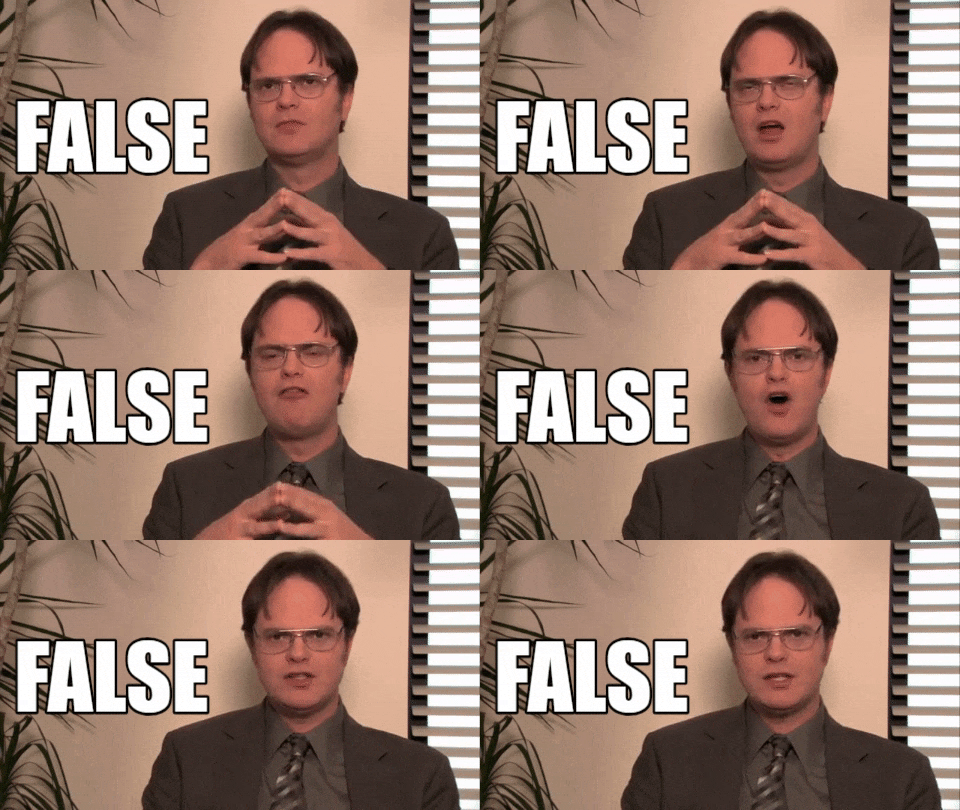
Wrong 😑
Your funnel just needs to match you, your business and the way your clients work.
And I’m going to stop you right there, because I hear you: “All my clients come from word of mouth, I still don’t have/need a funnel.”
Eheh, that’s where you’re wrong, because that’s also a funnel, not luck.
Also this is a narrow view of your work. If you get recommendations or referrals it means you did a good job at networking, don’t just say “It’s luck,” give yourself credit.
Your ideal funnel is probably simpler than you think
Let me give you a second example of how this actually works in practice.
Let’s imagine a freelance translator, I’ll call Sara. Academic philosophy texts only, super simple. So, her funnel has five steps:
- She’s known by maybe 30 people for one specific thing. Let’s say 3 past clients, 4 fellow translators in different niches, a bunch of editors in her niche, 2 researchers she translated for during her PhD.
- She keeps in light touch with them. For example when she finishes a project she’s proud of, she mentions it in a one-line email to two or three people who’d find it interesting. When a translator friend lands a big contract, she sends a congratulations. Four to six contacts a month in total and all very sincere.
- She refers work out too, and those people owe her nothing of course, but they will remember.
- Her touchpoint is always a 20-minute call before taking any job, to get to know the client and understand if it’s something she can take or if she can refer it to someone else.
- Project ends. She sends the work, the invoice, and if it went well, asks “If you ever come across someone working on [similar thing], I’d love an introduction.”
This is a very simple funnel that relies on a strong and well nurtured network for example, and as you can see there is no newsletter, content calendar or lead magnet. But because they’re not necessary for this particular business. But she knows her audience very well, and that’s how she built all this. This is what I mean when I say: your funnel needs to match your business.
Now here’s the myth I want to fight here: You don’t need a complicated funnel to be successful. You just need a good one that fits you, your business and your clients.
Meaning that you know your clients well enough to know where they look for and come from; You know which step leads to the next; You understand why some people convert and others don’t. This is how you should make decisions, not guesses.
What a more advanced funnel looks like
Now, easy is nice but funnels can be more complex indeed, so for the sake of education, let me show you what a more advanced funnel can look like.
Imagine someone who runs a group coaching program. Structured, systemic business.
Their funnel might be:
➜ Free content (blog, podcast, social)
➜ Lead magnet to gather emails
➜ Email newsletter nurturing
➜ Discovery call to get in touch with clients
➜ Low-ticket offer (something simple)
➜ Group program
More steps, channels and a longer journey.
It might sound complex, and it is indeed more compared to our previous examples but it’s because the business too is more complex, and it’s not as complicated as you think.
When you have a more structured business to run, you need to know what content brings in the right kind of person, because it allows you to save energy and resources when you’re growing and makes it more stable. It allows you to nurture relationships over time with less effort, as you might need multiple price points to serve different stages of readiness for example. So the funnel here needs more steps.
But keep in mind that this is built on the same principles.
And the reason I’m showing you this isn’t to make you feel like you need to have this or you won’t grow, but it’s just to show you that this is what happens when you become aware of your funnel, and how you can control it, because you understand it.
How to find your funnel: a 15-minute exercise
So, let’s recap:
- You always have a funnel weather you like it or not.
- Understanding the one you already have, allows you to take control and build on it and make your clients intake less exposed to randomness and fluctuation.
So the question isn’t: how do I build a funnel? The question is: how do I understand the one I already have?
And once you see it and can name each step and understand why it works, I promise, you stop feeling like you’re behind or clueless. You stop comparing yourself to the random case studies. You move from panic to strategy and start asking the right questions, like “how do I make my existing path more conscious and efficient?”
And it’s where the good stuff happens.

So let me leave you with a short exercise that can speed up your funnel work: Take 15 minutes this week and grab a piece of paper. Write down: where did my last three good clients come from?
For each one, trace the steps:
- How did they first hear about me?
- What made them reach out?
- What happened next?
You’re going to see your current funnel.
And if you can’t answer, or you want to go deeper on this I can help. My program is built to help you work on the basics so you understand who your ideal clients are, and how to structure your funnel based on it.
You got this,
Chiara
If you’d like to go deeper
Let’s map the funnel you already have.
In my group program we work on the basics together: who your ideal clients are, where they come from, and how to shape your funnel around them.


